The Judge’s Eye: Performing AT The Panel vs. Performing FOR Them
Impact Dance Consulting- The Judge’s Eye- Stop “Shouting” at the Judges: The critical difference between performing AT the panel vs. performing FOR them. Original post date June 1, 2026
We’ve all seen it happen from the audience: a routine starts, the music swells, and the dancers take the floor with an explosive, non-stop intensity. Their eyes are locked on the judges, their facial expressions are dialed up to maximum volume, and every single count is packed with high velocity energy.
As a coach, it feels like your team is leaving everything on the floor. But when the scoresheet comes back, the performance and artistry scores don't reflect that massive output.
If you’ve ever found yourself staring at a scoresheet wondering why your team’s intense energy didn't translate to the panel, it's time to break down the actual psychology of the judging table. There is a difference between performing at the judges versus performing for them.
THE DEMAND FOR ENERGY
Let’s acknowledge the real world standard of the competition stage first. Projection, performance value, and dynamic range are essential competitive tools. In high energy categories like Pom, Hip Hop, or Jazz, a flat presentation could stall out your score. Dancers must know how to project their energy to the back row of an audience, and training them to command a room is a core part of coaching.
But here is a strategic adjustment: For the vast majority of competitive routines, forcing non-stop, artificial intensity doesn't draw the panel in, it pushes them away. From the judge’s chair, constant, unyielding intensity doesn't look like passion.
It feels like shouting.
THE "SHOUTING" MISCONCEPTION
When you attempt to impress a panel through a preprogrammed checklist of forced facial expressions and unrelenting energy, you run directly into The "Look At Me" Trap.
A judge spends MANY hours sittings at the table, processing hundreds of routines. When a performance relies on artificial intensity, the judge experiences immediate sensory overload. To protect their focus, their brain naturally tunes out the noise and mentally disconnects from the emotional journey of the piece.
Here is the ultimate insider secret: The exact moment a judge disconnects from the story, they stop watching and start hunting for technical errors.
When you perform at the judges, you force them into the role of an evaluator. But when you teach your dancers to perform for the judges, you invite them to become fans of the work.
A judge is impressed by your team’s execution, but they are deeply moved by their sincerity. We want to experience an authentic unfolding of the music. When a dancer's expression feels like an organic, gut response to the movement rather than a choreographic requirement, the judge stops "watching" the routine and starts "feeling" the story.
AUTHENTICITY is your best defense on the scoresheet. If a judge is genuinely swept up in the humanity of your piece, they aren't hyper-focusing on the minor technical imperfections.
📌 PIN THIS POST FOR LATER
Want to keep these performance exercises handy for your next studio rehearsal? Hover over the image below to pin it to your Dance Coaching Tips or Choreography Strategy board on Pinterest!
Impact Dance Consulting- Coach Fix Ideas For Performing FOR the Judges. Original post date: June 3, 2026
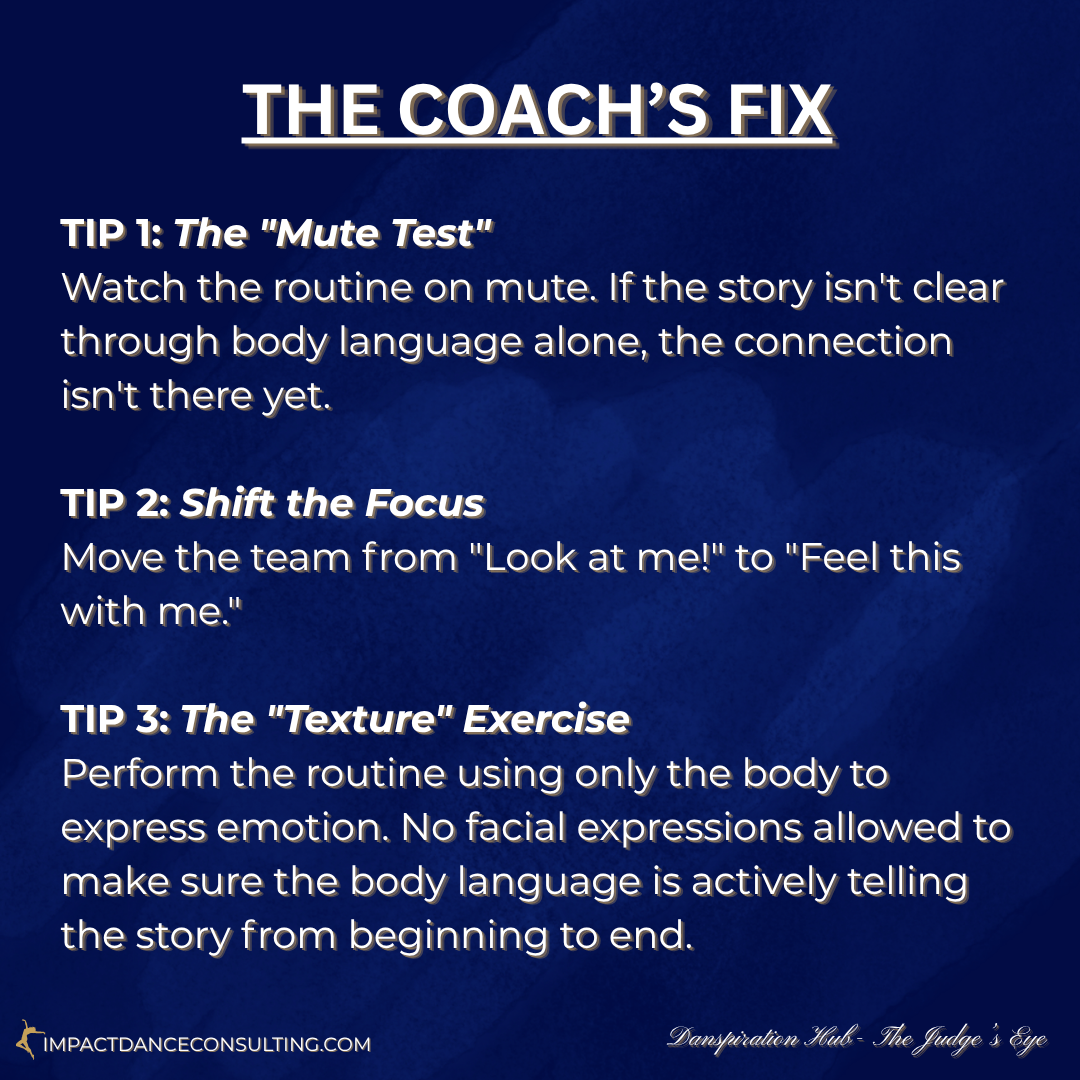
THE ACTION PLAN: THE COACH’S FIX
To break your dancers out of the "checklist" mindset and build true emotional clarity that connects, try these three exercises before/at your next practice:
THE "MUTE TEST": Watch a video tape of your routine completely on mute. If the emotional arc, the intention, and the storyline of the choreography aren't crystal clear through body language and emotional expression alone, your connection isn't reaching the back of the audience yet.
SHIFT THE INTERNAL CUE: Change the language you use in the practice space. Move your team away from presentational cues like "Look at me!" or "Sell it to the front mirror!" Instead, anchor them in collaborative intentions like "Feel this moment with me" or "Invite them into the space."
THE "BODY ONLY" TEXTURE EXERCISE: Run the entire routine with completely blank, expressionless faces. Force your dancers to rely entirely on their core, their weight shifts, and their physical dynamics to communicate the emotional texture of the piece. Once the body carries the intention, the face will follow naturally.
Clarity will always outscore exaggeration. Stop teaching your dancers to "big-face" the routine, and start training them to embody the work from the core out.
Ready to stop guessing what the panel wants to see and turn your choreography into a real conversation? Let’s get a completely objective, unbiased look at your routine's performance quality and technical habits before you step onto the competition floor. Through The Judge's Eye Routine Review, I will help you identify point leaks, unlock authentic stage presence, and build an execution plan with to enhance your competitive clarity.
