A Dose Of Danspiration- “The Dance Team Coache’s Guide to Cleaning Routines: How to Organize, What to Look For, and Different Ideas for Drilling and Setting Routines.”
Cleaning a routine isn’t just “fixing mistakes,” it’s refining details, building consistency, and teaching dancers how to dance AS ONE. Even when major errors aren’t happening, Many Small Inefficiencies = Large Problems.
Below are tips on how to organize, what to look for and different ideas for drilling and setting routines that can be used with all styles and designed specifically for dance team coaches.
Precision = Points Clarity = Confidence
Before You Begin: Set the Tone
Enter the cleaning phase with realistic expectations and a positive mindset. Cleaning is not a sprint, it’s a slow, methodical climb. There will be challenges, but persistence and clarity can reap great rewards!
Before you dive in, ask yourself these four questions:
1. WHO are you coaching?
#1 thing to remember…EACH DANCER IS DIFFERENT! Different flexibility. Different body structures. Different learning styles. You will get the most out of those that you coach if you adapt your teaching. For example: hyperextended dancers need different cues than non-hyperextended dancers. Some dancers have structural limitations. Some will interpret your wording differently based on their past experience.
When providing corrections, swap vague cues for specific ones.
Instead of “Be sharper.”
Try: “Press your shoulders down, draw your shoulder blades together, and feel tension in your armpit muscles.”
Be patient. Be flexible. Be specific.
Be an educator, not just a corrector.
2. WHAT are you cleaning for?
Is this routine for a performance?
A football game?
A competition?
Performance-focused routines may need more work in memory, spacing, and entertainment value.
If the cleaning is competition focused, WHAT competition are you preparing for? WHAT is the end goal of the team?
3. WHEN do you start and finish cleaning?
Set a timeline.
WHEN will you begin cleaning sections?
WHEN do you want the routine completely cleaned?
WHEN do you switch from cleaning → drilling → running full-outs?
Without a timeline, cleaning expands to fill all available rehearsal time and that deadline may creep up on you sooner than you realize!
4. FINALLY, ask HOW will you clean the routine?
Decide:
HOW much practice time goes toward cleaning vs. other demands.
HOW will you structure your cleaning (sections, eight-count blocks, skills-first, etc.).
HOW will you track your progress.
One Last Step Before Cleaning Begins: Set Standards and Hold Accountability
Take time to clearly define what “clean” looks like to your team.
Create a team culture where it’s encouraged that dancers help correct each other in a constructive and positive manner. Educate how you would like to see this happen, then model it in your own delivery.
Also, set the expectation that dancers hold themselves accountable during practice. By listening to all feedback and applying it to themselves this can expedite the cleaning process.
Once everyone understands the expectations…time to get to work!
BREAK IT DOWN INTO SECTIONS
Don’t clean the routine as one giant piece. Break it into digestible blocks.
Try this approach:
Count how many 8-counts are in the routine.
Determine how many practices until your completion deadline.
Divide the 8-counts across those days (ex: 4 eight-counts per practice).
DO NOT move forward until the current and previous sections stay clean.
If teaching the routine AND cleaning it, give yourself enough time to give both sufficient attention.
IF THIS A COMPETITION ROUTINE:
Study the score sheet for your BIG or final competition. See what different categories will be scored at that competition. Most companies, at the very least, provide a list or sample scoresheet on their website.
Common categories include:
Choreography (difficulty, staging, musicality, creativity)
Movement Execution
Technical Skill Difficulty & Execution
Showmanship / Projection
Transitions
Spacing / Formations
Judge’s Observation: Coaches often over-focus on execution and technical difficulty. Judges score the whole routine, so everything matters. Address all the categories throughout the process!
ADDRESSING THE MOVEMENT
Movement: Timing + Technique + Pathways
Precision in timing is huge, but so is HOW dancers move. Tiny adjustments instantly elevate the overall look of the routine. Judges are trained to find small timing/execution inconsistencies, so breaking down the movement to the smallest details is what separates teams by tenths of a point.
Look at how the dancers are getting from one move to the next. A few examples: Leading with knee in a battement will get the dancer to the peak of the kick differently then brushing off the floor and maintaining a straight leg. If the arms are in a high V and they need to break to a low V, where will that break go through? Will the elbows pull into the torso and then fold out to the low V? How the arms move through the negative space around the body will create different timing and a different pathway.
Don’t forget…DYNAMICS!! Engage what I call the “Power Zone.” This is the engagement of the upper back. By pressing the shoulders down, pulling the shoulder blades together, and feeling a little tension in the armpits, the energy with which the movement will be able to be executed will change. There can be quick sharp movement and stronger, slower movement. This ability to execute different textures in the movement adds so much to the piece and by everyone engaging their “Power Zone”, everyone will initiate from the same area with the same intensity and it will help loads with the uniformity!
Lastly, be aware of cleaning a routine too much that the style is lost!
TIP: When watching, if you do not have specific expectation, find the individual that is executing the movement/sequence as desired and utilize them as your example to educate from.
BODY ANGELS/LEVELS
This is a very important element to address. The way a dancer stands greatly impacts the visuals and uniformity of the movement. Body angles make or break visual cohesion.
Instead of vague directions like “face the front right,” try teaching angles using the Vaganova Ballet Method or what I call, the “personal box”:
Place the feet together facing front = #1
Toes diagonally right = #2
Facing right wall = #3
…and so on. *See image below
I have seen tremendous success with body angle execution by applying this method.
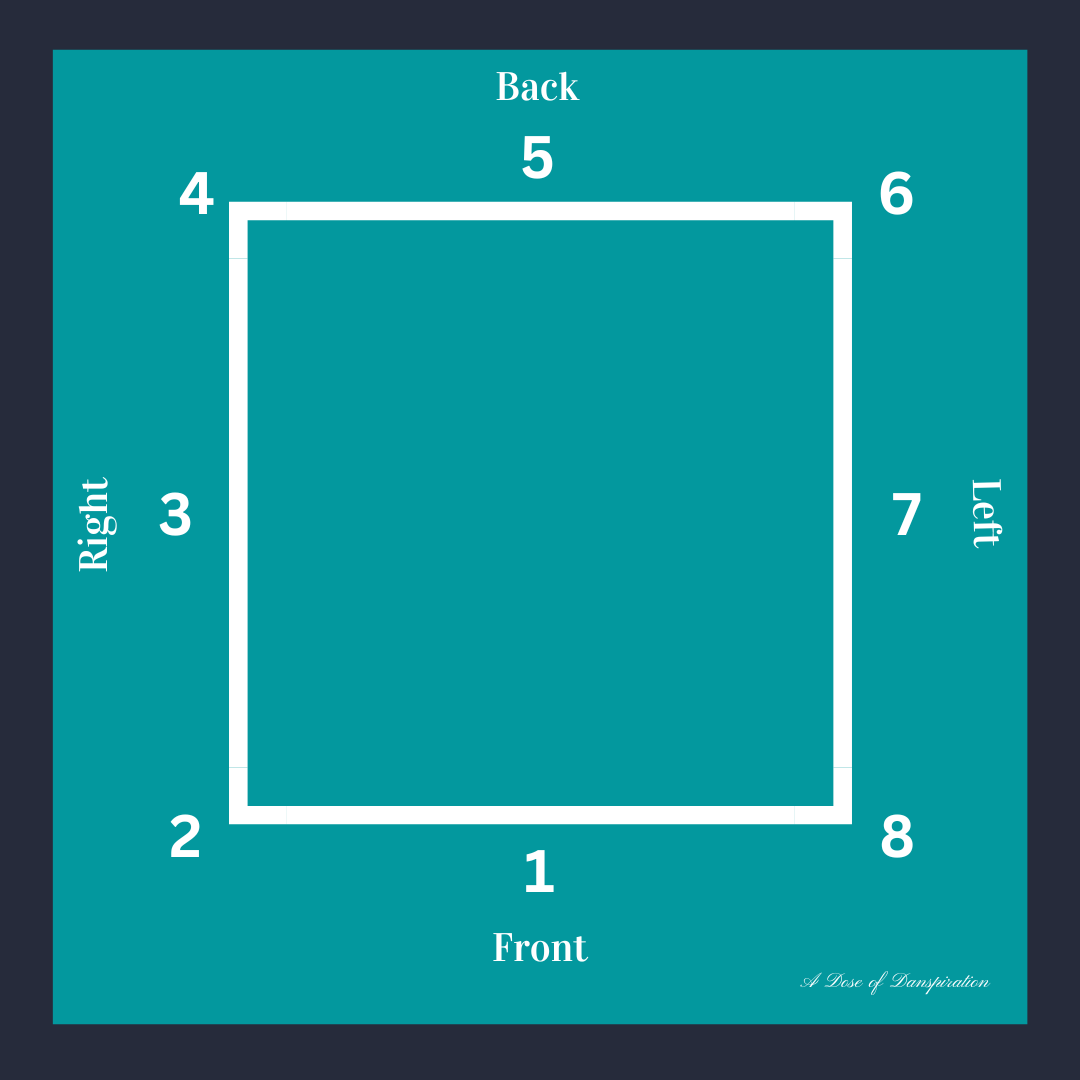
Visual of Vaganova Ballet Method /“personal box”
LEVELS MATTER TOO!
Are the dancers at the same height? When in plie, I have found that dancers don’t engage their quads, glutes, and hamstrings. They simply bend at the waist and “bend” the knees. Make sure they are utilizing that lower body!
DON’T FORGET… head placement! Is the head up right? Is it tilted? Are we looking to #3 or #2? (see how I used the “personal box” with head placement expectations😉 )
JUMPS/LEAPS/TURNS
Address going into AND coming out of skills! The group should start together AND finish together! Make sure all are executing with the same intensity. For example: one dancer snapping their legs together out of a toe touch vs. another floating down and maybe landing with feet slightly apart. Address questions like; “Do you step in front or behind in the prep?” “Do you end on count 4 or 5?” “In second or together?”
Tip: Give all pirouettes counts vs. “how many times do I turn?”
PRESENTATION
Cleaning isn’t only technical, it’s emotional. Inconsistent emotional expression from dancer to dancer can keep a performance from truly shining.
The number one question to ask is, “What emotion do you think this piece evokes?”
Authentic emotions are projected head to toe.
To dive deeper into authentic emotional expression and a game to play with your team, check out the blog posted earlier this month (December 15, 2025) titled: “PERFORMANCE TIPS: The Emotion Factor: Turning Choreography into Connection.”
A quick recap…
Make the emotional expectation very specific. An ambiguous response that I commonly hear is, “Dark.”
What does that mean? Menacing, sulky, angry, threatening, depressed? Just in these listed interpretations, there could be quite a variation in how “darkness” is expressed.
Next, ask them how they would AUTHENTICALLY show that with their WHOLE BODY.
Our emotions are not solely expressed with our facial expression. We feel with our WHOLE BODY, from head to toe, from inward to outward.
Practice tapping, full body, into the specific emotion every time the piece is practiced.
EVERY. TIME.
MUSICALITY
Every movement should align with the beat, accents, and emotional tone of the music. Musicality transforms a clean routine into a performance that connects with the audience. Musicality is what transforms “clean” into “captivating.”
Next month, I will be posting a blog titled: “Your Musicality Sundae: A Sweet Strategy for Bringing Music to Life.” Where I discuss how, when done right, the choreographer and dancers can create this amazing musicality sundae. To touch briefly on the dancers’ portion, or the execution aspect, it’s the dancers’ responsibility to make it very clear what is being expected of them by, what is commonly referred to as “staying with the pocket of the music” and “dynamic execution.” The performers do this by moving the body to the beats/sounds/lyrics/etc. Executing the movement with the understanding of the movement’s intention, such as; smooth strength or staccato sharpness. They are tasked with being the vessel that brings the music to life. Hopefully the choreographer has taken the time to pull out the musical nuances and give a strong starting point, then it is up to the dancer to study the movement and understand the music to bring all the layers to life in the performance.
FORMATIONS
Dancers need to understand that no matter where they stand, they are VITAL to the overall picture. They cannot creep into a space to see in a mirror or so mom/dad can see them. I describe it as a jugsaw puzzle. If a piece is not where it belongs or the piece is slightly off, the picture looks odd in that area. To truly appreciate the beauty of the picture, every piece needs to be exactly where it belongs. Additionaly, making sure the dancers use their lower body the same and go in and out of skills the same will help greatly with the dancers being able to stay centered in their window or directly behind another.
Tip: Take a look from the side and see if the dancers are not standing deep enough back from line to line.
Know your performance space. You may have a huge studio, but a limited competition floor, pick shapes that suit where you will be competing. If it’s a smaller group, don’t be afraid to use the stage more. Really use all 4 quadrents of the performance space!
TRANSITIONS
Smooth transitions make the routine feel effortless.
Things to look for :
Walking with the same foot, not studder stepping or “ice skating.” *Sometimes dancers need to use the opposite foot, try to make it discreet.
Does everyone start and stop moving their feet at the same time?
Can they get to the formation? If not, see if you can do an easy change with another dancer or consider changing the shape or change the transition. A dancer should never studder step or look like they are running when others are walking. Example: If you have a dancer that needs to go from the front to the back, maybe everyone faces the back for 3 counts and then faces the front for 2.
Some may have to move in place or be given different movement to enhance that part of the routine, not every dancer needs to transition at the same time.
How they move THROUGH the space is also important. Consistently marking a transition or moving how they feel comfortable, can be distracting and take away from the flow of the piece. Collisions should rarely happen if the transition is always being rehearsed.
TIP: Avoid moving a lone dancer across the center of the floor. When a dancer moves to the opposite side and no one else moves that direction, it pulls your attention to them. Try adding shorter transitions to make the transition smoother and less obvious.
CELEBRATE PROGRESS
Don’t forget to highlight improvements!
Positive reinforcement motivates dancers to maintain high standards and gives them confidence to keep pushing.
Think of a reward for staying on task and working hard that occurs at different points throughout the cleaning process. Maybe if they reach a goal in cleaning, you take a practice and do a fun team bonding day instead of cleaning.
LASTLY, determine when it is time to stop drilling and just re-work a part.
ADDITIONAL TOOLS & IDEAS
1. VISUALLY MARK YOUR SPACE
Put tape on the floor when first learning and cleaning. Find center and mark it. Put a piece of tape so many feet out in the front and back of room and divide up the room. If you are a high school team dance on the gym floor, most have center line, center circle, free throw lines, etc. Measure them out on the floor and transfer that to where you practice. Put a piece of tape down where you want the routine to stop moving forward to. This will help pull a routine back verses everyone dancing on the front of the performance area.
Can’t use tape? Get creative, but make sure it still keeps the practice area safe.
Maybe put numbers across the top of the mirrors that are equal distance apart. Work your way out from center.
Create tape markings on a rope or programs have made portable panels that have the floor markings to be laid out across the front of the floor to guide where marley lines would be.
Once closer to a competition, remove the markings, except center front. The hope is that muscle memory will take over and they will automatically go to their assigned spot.
THEN, flip them around to the back of the room or the side of the room. This will force them to get out of their comfort zone and rely on each other and instinct, like a competition.
2. TEMPO CHANGE APPS
There are many apps out there where you can load your song into the app and adjust the tempo of the music. Slow it down if you are needing to get an intricate section cleaned and understood. Then work your way back to up-tempo. Also, you can have a little fun and adjust to a tempo that is too fast and see what happens (usually a lot of laughter!)
3. BRING IN A NEW SET OF EYES
Bringing in another coach, consultant, or trusted colleague who can spot things you’ve may have become blind to. Can’t get someone in, at least share a video and get their feedback.
**If you are looking for someone, you can reach out to me (Deanna) at Impactdanceconsulting.com or any of our socials and I would love to opportunity to come in and help your program. If in person doesn’t work in you budget or schedule, we have a virtual option too!
4. FEEDBACK JOURNALS
Besides having dancers write down important individual & group feedback, you can also have them partner up. Have one dancer watch and the other dance. Then the individual who just performed gets out their notebook and the dancer who watched shares feedback as the dancer who performed writes it down. Is there repetitive feedback? The dancer can see what they need to work on. Always change the partners up. This activity builds accountability and awareness for both dancers.
5. VISUAL FEEDBACK
Video recording is your best friend!! Video every competition. Video tape the routine every two weeks. Let the dancers see it. Some dancers are just not as connected to their body and need to SEE what you are talking about. Watching themselves allows dancers to self-correct.
6. COACH EVALUATIONS
This idea is very time consuming, but so powerful.
Take the routine and map out on a sheet of paper or Google doc.
Watch each dancer individually on a video and
Give corrections per 8 count as to what needs to be fix or what they did really well!
Then have the dancers watch video with your feedback.
In my experience, this accelerates improvement FAST.
ADDITIONAL THOUGHT…Let the routine be always evolving, don’t get too hung up that the routine should be what it was to start with.
LASTLY…Don’t get so hung up on changing the routine that you put aside cleaning a routine. A clean routine can go A LONG way with judges.
